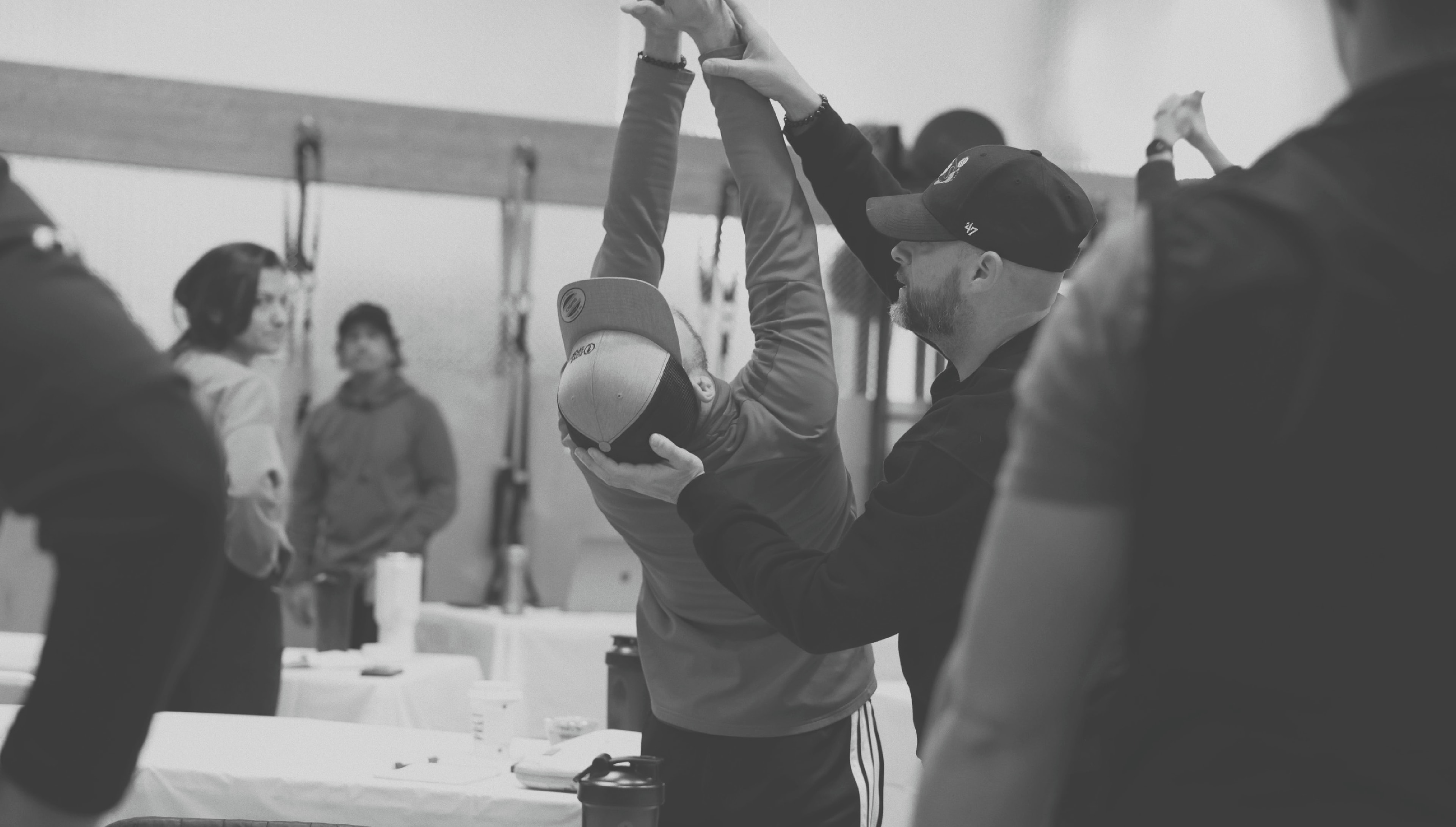
You're a kinesiologist or strength coach and you wonder why it's so hard to correct your client's muscle imbalances?
You've stretched them and worked unilaterally and there's still tension and weaknesses?
The IP Method is for you!
For the first time, you'll learn concrete tools (stimulations, neurological exercises) to identify and correct your clients' muscle imbalances by addressing the cause of the imbalances.
Sometimes, to move forward more effectively, you have to go backwards!
It's between 0 and 1 year old that we develop our brain-muscle connection. It's about time we recognize this and act on it!
In this Level 2, you'll get 9 sessions of 2 hours (18 hours total), you will master no less than 10 tests and 50 exercises to recommend to your clients as a neurological warm-up to get them to recruit the muscular system in the most economical and efficient way!
It's the age of neuromechanics!
Welcome to #ipvibes!
A total of 50 never seen before exercises
9 online sessions of 2 hours each:
Session's 1 Content:
The perceptual motor stage:
Level 1 recap
Eye-Hand Coordination
Scapular chain: theory, tests and practical exercises
Session's 2 Content:
Eye-hand coordination (continued):
Quadruplegia: theory, tests and practical exercises
Piaget's model
Session's 3 Content:
Postural adjustment:
The vestibular system: theory, tests and practical exercises
Everyday activities
Session's 4 Content:
Postural adjustment:
Lateral muscle chains: theory, tests and practical exercises
Session's 5 Content:
Sensory integration:
Squat: from embryology to performance
Are motor preferences preferences?
Session's 6 Content:
Sensory integration:
Integration of sensory inputs
Signs and symptoms of poor sensory-motor integration
Session's 7 Content:
Proprioception:
The vestibular system in depth: stress response, cognition and emotions
Postural adjustment: tests and practical exercises
Advanced proprioception: theory, tests and practical exercises
Session's 8 Content:
Analysis of daily activities:
Walking:
Joint mobility and motor patterns: ankle, knee, hip, lumbar, back and shoulder
Evaluation of walking through muscle testing
Session's 9 Content:
Analysis of daily activities:
Rotational movements
Bench press: from embryology to performance
Behavior: the non-motor role of the frontal lobe
18 hours of exclusive video content
Lifetime Access, Learn at your own pace
100% Online, learn from anywhere in the World!
Downloadable PDF Documents
Electronic Certificate awarded upon succuessful quiz

399,99 $
Lifetime and unlimited access to content.


